Wednesday, August 24, 2011

The Poetry of Reality

The Symphony of Science. Or you could call it the symphony of a simple, elegant, wonderful idea. Thank you John Boswell and all those great scientists and others responsible for the collaboration.


There is nothing I take greater pleasure in doing than sharing creativity - yes of course my own, but mine is but like one of four billion insipid flickering lights - and ultimately it takes a collaboration of stars to see a constellation. The Symphony of Science is the creative genius of composer-producer-creative John Boswell seeing constellations while the rest of us see stars.

"There's real poetry in the real world, science is the poetry of reality." Visit the Symphony of Science website and enjoy many, many more constellations.

Monday, August 22, 2011

The price for letting the world look through your eye

Most days are filled with research and preparation on the latest, but in many ways my oldest project, The Great Ape Diaries. One element of that project will be to work with award-winning documentary film-maker Skye Fitzgerald. In our last meeting Skye discussed a film technique he would like to use. One where you, the viewer, will share my perspective as I create images, in the digital diary posts we make. Skye suggested I watch War Photographer, a film by Swiss author, director and producer Christian Frei.
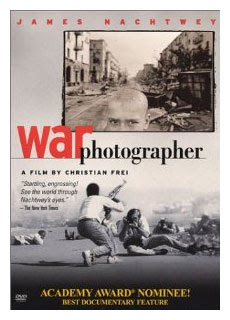
Frei followed photographer James Nachtwey over the course of two years into the wars in Indonesia, Kosovo, Palestine, and Nachtwey's pursuit of poverty and famine, ostensively as a by-products of war. In addition to an exterior perspective on what Nachtwey was experiencing, Frei used special micro-cameras attached to James Nachtwey’s 35mm still cameras. The approach surrenders a feeling of not just being in his shoes, but in his 'other' eye. I shoot this way, with both eyes open, a technique a taught myself years ago--the better to see the world moving in and around the frame. The documentary is a decade old, but the personal "in-sight" point of view or POV remains fresh and refreshing, even in this iPhone Youtube consumed world.

That POV is what Skye is interested in working out with me as we create The Great Ape Diaries - we'll discuss that more over the coming months on this blog. Our advantage of course is a wealth of new small HD video cameras like the Hero Pro. Still the challenge remains creativity and simplicity of communication, and that was the reward in watching Frei's War Photographer.

After some thought about the Academy Awards nominated documentary, I don't think it can be discussed outside Frei's microcam technique, although most online reviews and discussions are determined. Most of the online debate after the film debuted in 2001 were focused there, negatively and positively, on the age old reportage argument regarding war/tragedy: Is the photographer/journalist a cold and cynical chronicler, or should their humanity step forward and intervene in what they are bearing witness to? Or at the least step away from feasting on the pain and suffering of others? Words like vampirism, vulture, scavenger and leech were peppering the comments. Nachtwey's apparent calm translates as callous, his thoughtfulness as heartlessness, these have always been the leading volleys of critics. Unfortunately, to bolster their objections, there is one elongated scene in the German offices of Stern magazine where editors discuss an upcoming layout of Nachtwey's images in terms that translate into the hands of cynics; describing Nachtwey's horrors of war black and whites with adjectives like, "Fantastic" and "Ya, this great, terrific."

The micr0-cam I think does yield more than just a POV on the images Nachtwey creates, but on Nachtwey himself. As Skye has said to me, "I want to get in your head as you're back creating these photos." And any careful observation of the War Photographer I think does that. We, the viewer, have 96 mins of self-determination about what a war-photographer-kind-of-human James Nachtwey is or isn't. That kind of exposure causes me pause going forward on The Great Ape Diaries. A bit of fear. There is a price for letting the world look through your eye.

One of the last comments Nachtwey gives into the camera, and there are remarkably few, is regarding his role as image-maker in such conditions, "It's something I have to reckon with every day because I know that if I ever allowed genuine compassion to be overtaken by personal ambition, I will have sold my soul."

Again, critics may attack in their belief that "genuine compassion" begets involvement beyond the images, and Nachtwey's words are little more than hollow excuses, his soul was sold. But having met the man in an unflattering state, he is paying a price, and the images are a price to know reality. Nachtwey says earlier in the documentary about the genocide in Rwanda, "It was like taking the express elevator to hell." Never be so naive as to think that ride has no price. Having visited the suburbs of hell myself on another scale - no one else can fully judge the price.

*****

Finally this note. The sound track is as subtle and wonderfully done as anything you may never notice, but should. As someone said, "One of the most profound aspect I found in this documentary, is the use of sound. I think it's one of the best, if not most calculated sound editing ever done, since the film [is] supposed to focus on images."

Friday, August 19, 2011

Beauty in the Beast

Technology is a strange beast - most of it is pointless - I mean we do really pointless, self-destructive things with it - the stockmarket, automobiles, weapons, GMOs, plastics, computers, cell phones - the list is seemingly endless; Crap, we justify as critical to our lives. After the emergence of a technology, it's refinement, maybe it's ubiquity, it falls in the hands of artists. Then, and only then, do we discover the beauty in the beast.

It never was just a phone - we just didn't quit talking and texting long enough to see

The above was shot entirely on a Nokia N8 mobile phone. Winner of the Nokia Shorts competition 2011.

Friday, August 5, 2011

When I'm Not Traveling - I Miss Traveling

Travel - a passion for moving, learning and eating.

My alternate eyes and ears and soul in the world - Jenn - just shared these three short films with me. Damn I'm missing not traveling!!

MOVE from Rick Mereki on Vimeo.

PS - be sure to visit the Vimeo site to see all three films

Tuesday, July 26, 2011

Searching for gorillas, not gravel roads

I have a friend who I cycle with regularly. His life is working successfully at being paid a handsome sum for a large international tech firm and avoiding anything that resembles work - this is his own admission not my summation - and et in as much cycling as skipping work will allow. On weekends when we make longer cycling days of it, a hundred miles or so, and more climbing than mountain goats do, we invariably end up on a road he thinks is 'good', invariably it is gravel. So we end up on our expensive carbon road bikes pedaling over gravel. Stupid. Why? Making life hard invites disaster - survive disaster it's adventure (which they then make into some cheesy reality show) - which he needs and has none of in the rest of his life. I think he looks at my career and wishes for a bit of that adventure cum disaster and hardship.

Years ago I was doing research for my first trip to document mountain gorillas in the highlands of the Central African Rift, the Virunga Mountains, where Rwanda, Uganda and then Zaire shared a steep, wet, green relationship. I was reading big mammal biologist George Schaller's The Year of the Gorilla in which he writes,
"Adventure implies hardships and accidents, which are usually the result of poor planning... Our expedition accomplished...what we set out to do without much trouble and,...without great effort."
I found myself reading that over and then over out loud. That made sense. Schaller got a heap of work done, work that eventually every mountain gorilla researcher and conservationist since, including Diane Fossey, has relied. The Virungas have enough gravel roads, neither Schaller nor I needed to look for them. In fact, we got over or around them as efficiently as possible, that left more time for discovering gorillas.

Over the years I have been asked repeatedly about the "struggle" and the sacrifice in becoming a photographer (now with success.) I know what they want to hear. They want an edge of horror, of pain, of suffering, something like what I recently read about Pablo Neruda:

At the age of 19, he set out to publish his first book. His family disapproved of his writing, so he chose a pen name: Pablo Neruda. He struggled to find a publisher. Eventually the Chilean Students' Federation agreed to publish the manuscript, but Neruda had to pay all the expenses. He said: "I had setbacks and successes every day, trying to pay for the first printing. I sold the few pieces of furniture I owned. The watch which my father had solemnly given me, on which he had had two little flags enameled, soon went off the pawnbroker's. My black poet's suit followed the watch. The printer was adamant and, in the end, when the edition was all ready and the covers had been pasted on, he said to me, with an evil look: 'No. You are not taking a single copy until you pay me for the whole lot.'"*

Heck, my first book came with a $15K advance, another $10K in corporate support, free airfares and four amazing years living in Australia and Papua New Guinea.

"without much trouble and,...without great effort." That's what I want to tell them. The plan wasn't super detailed, it allowed for adaptation and evolution, years following a twisting road through university bio classes taught me that. But it didn't include gravel roads. Struggle is stupid. Disaster is stupid. They waste time and time is precious if life is successful.

Recently I have begun to reconsider the struggle again, as I return my attention to mountain gorillas. One doesn't struggle traveling if you love traveling. One doesn't struggle writing if you love writing. One doesn't struggle learning a new language if you love learning and languages. Sure everything has a gravel patch, but you don't go looking for gravel roads.

*(His second book, published a year later, was a book of love poems: Veinte poemas de amor y una canción desperada (Twenty Love Poems and a Song of Despair, 1974). This book made the 20-year-old poet famous.)

Tuesday, July 19, 2011

Who holds the copyright to a picture taken by a monkey?

Interesting copyright thoughts in a short article about the macaque monkey picture I posted a few days ago in Always Better Lucky Than Good:

Wednesday, July 6, 2011

Always Better Lucky Than Good

Crested black macaque smiles for his self-portrait while using the camera belonging to photographer David Slater in an Indonesian national park