Wednesday, November 17, 2010

Pub, Pints and Petroleum Politics

I don't know if I always had a journalist gene, or it's just something that intertwines itself within the double-helix for curiosity, but stories that don't walk a straight line fascinate me. Especially stories that don't just dip their toes, but wade waist deep into the confluence of environment, politics, conservation, money. Any one of those, combined with the erraticism of human nature, would be enough, but find that wedding of the waters and you better start looking at the local levies - something eventually will give. Maybe what intrigues me even more are the convolutions that the various channels take, and the moments of serendipity. Those moments I'm finding are often over a pint in a pub.

You can just call it drinking, but it's more. It's journalistic in perhaps the oldest sense of the craft. A filtering process refined in the great newspapers and radio days, and polished in the early years of television. Sorting on the fly what is and isn't helpful verses pure raconteur BS - which of course can always lend a bit of color. Out side the DC beltway, and unless you are overseas, there seems to be less hard stuff being drunk these days, but a couple craft beers, local brews, do just fine.

Some watering holes work better than others. Each locale has its flavor and approach. I'm not skilled at them all - yet. For example I'm not good with bad beer. In other words, fishing dock lounges are my Achilles heal. The kinda places where the lingering combination of grease and cigarette smoke veneer even the clean flatware, and the smell haunts you in your motel room even the next morning as you stare in disbelief at the paisley-plaid curtains (yes, somebody really did think combining those two was a good design idea.) Places where nothing on tap, or more often bottled, is darker going in that it is coming out. Beers often referred to by the person behind the bar as "beer product" and generally bear the label "lite". And all of the establishments start and end with someone's first name - women's names are the worst for me, they hold the promise of cleanliness going in, then dash your hope and smother your senses.

Yesterday afternoon I visited one of my favorite pubs here on New Orleans' Magazine Street - finally yielding to that little voice. The same little voice that over the years tells me, "talk to that guy or gal sitting next to you" and I finally relent to discover a valuable lead or relationship that far exceeds the cost of the local draft microbrew.

There were just two of us sitting outside at 4PM and serendipity killed the power on the outlet he was using. So laptop in one hand, pint in the other, here he came. Sharing an outlet bonds you in this digital age, the way a bad cab ride or train trip did a couple decades ago, or a five-day monsoonal rainstorm in the third-world still can.

An hour later, and half a pint (second round) remaining, we shut laptops and commented on the weather - snow up north in home towns. My home town, Portland, was his envy. After this was over he would like to head there. This, turned out to be the BP mess. Serendipity. Much of the next several minutes was peppered with him saying, "off the record", but, in their turn comments, facts and anecdotal debris floated down several of the above mentioned channels, pushing me closer to the confluence of this oil mess. Information like, there are places people just aren't looking, "there's $5 billion in charter fishing in the Gulf", why isn't anyone talking to these guys. Yes, follow the money.

I'm headed for Grand Isle this weekend based on that last half pint. My Nawlins "Deep Throat" connected me to other activities, separate, out of Grand Isle. A coastal confluence. All channels seem to be flowing south to Grand Isle - now if the island just had a good pub!

PS - I debated on where to post this, here or over on my general blog Perambulations - in the end both - it's as much a Louisiana/Gulf story as general journalists journey.

Thursday, November 11, 2010

"...a little rain must fall,"

"Behind the clouds the sun is shining,
Thy fate is the common fate of all,
Into each life a little rain must fall,
Some days must be dark and dreary."
- Longfellow

"Into each life a little rain must fall", hmmm? We live on a watery planet. We are bound by cycles of precipitation. So naturally a little rain must fall. It's that ambiguous "little" that changes the equation and turns daily life into chaos. Turns a tropical trip into a chance to reconnect to being an Earthling sailing together on a lifeboat through space.

As a photographer few things strip life to its barest necessity like chaos. Images seem to emerge from what hours or days before seemed, as my Costa Rican friend Rudy Zamora would say, "tranquillo". Chaos comes in all forms, some predicted, some thrust upon its victims - be it war, famine, natural disaster, or in this case a little too much rain.

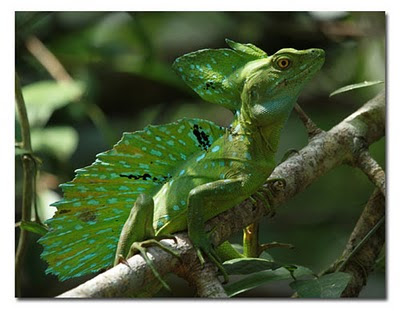
The past couple weeks in Costa Rica were the great yin-yang of traveling that makes traveling the wonderful experience I crave. The first nine days were near perfect - well, from a photography and bird-watching point of view. The chronically rain drenched Tortuguero N.P. was clear and hot. The surf rolled onshore and lured hatching baby sea turtles to sea each night and dawn. Scores of migrant song birds decorated the trees. Basking basilisks. Quiet paddling in the backwaters of the "baby Amazon."


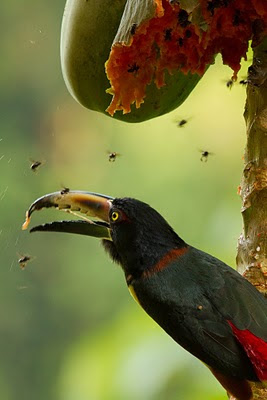
In La Selve the rain came only one afternoon. In classic form. The sky swelled in humid heat and loomed with steely-hued cumulus. The rainforest cicada ratcheted up their mechanical rhythm and then the firmament exploded with a blinding flash and a thunderous clap - seconds later the downpour was on. We escaped and took refuge in the open bar, and toasted the tropical deluge with cold indigenous libations. Afterwards watched Aracaris share tree-ripened papaya with stingless bees.


In the mountains along the Continental Divide from Arenal N.P. southwest to Monteverde Biological Reserve light showers drift in and out of each day, as expected, this is the tropics, this is rainforest.
Even at a young age a baby Guan knew this rain wasn't going to be fun
and stuck close to mom.

The last week it was time for the other reality. The one where "...a little rain must fall,"

Over the past coupe decades of travel I've discovered most chaos slips in subtly, silently. The few contradictions being bomb-blasts from rebel factions or political protests, but even then the place had been compromised long before, you knew in your heart it was a rising tide.

The road less traveled - from Quepos to Manuel Antonio
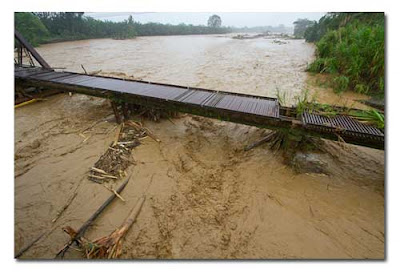
- at least the day after 16.3 inches of rain in 24 hours made it impassable.

The wonderful British travel writer Colin Thubron wrote, "You go because you... crave excitement, ... the need to understand something before it's too late. You go to see what will happen." I would add experience, not just see, what will happen. We always want to survive that place we go, but were or when we tip-toe that tightrope of survival we step into a new reality that never leaves us.

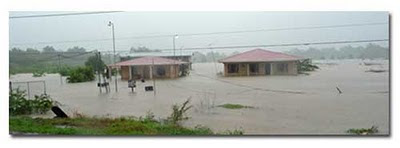
The tail of hurricane Thomas visits Costa Rica and out-stayed it welcome, turning the Pacific Coast into waterworld. A place where virtually nothing was high enough to escape the flooding waters.

Clarity, empathy, concern, global awareness, perspective, ownership, responsibility, Earthliness are all facets of the new reality. You finally emerge from the place where things happen and your days change. You check the news, surf the web, wonder why your chaos isn't news. Why where you know things happened it doesn't concern the rest of the world.

You learn sluggish sloths may die with full bellies, unable to digest in the soggy cold. You fear for friends, and all for the homeless you drive past, left sleeping on the road. You feel a refection of guilt because your wealth secures a life boat - this time. Your world has shrunk in all the rain. It has also become more lush. Rising waters have pushed up your experiential fecundity. You do it enough and soon the whole world is your street, your town, your neighbors. Your parochial blinders washed off - you see the world with your heart and soul.

My thanks to Rudy Zamora for making the past couple weeks a brilliant experience.

Tuesday, November 9, 2010

Only One Hummingbird Still Makes A Magical View

The rain began falling this morning early, just at dawn. Cold and soaking. Northwest winter rain. The kind for which we have received a tarnished, if not rusty, reputation. Truth is we don't like it much either. As much as it chills me to the bone I always imagine the toll on creature without the luxury of a space heater and cuppa tea. Over a dozen species of birds, little feathered souls, have flocked to the backyard feeders to fuel against the chilly downpour. My past couple weeks away in Costa Rica seems to have caused them a bit of concern - especially the diminutive dragons - Anna's hummingbirds.

With the hummingbird feeders full the Anna's, feisty three-inch hummers, have filled their bellies with sugar water and have returned to squabbling over the remainder - more of the sweet liquid than any one of them could possibly slurp up on their on. If birds did indeed evolve from dinosaurs then I fear what a 10 foot high version of these little bullies must have been like.

Peering out the kitchen window at one little male, his head swiveling side-to-side, alternately flashing the most brilliant ruby-violet color imaginable, I flashed back on one week ago, standing in the edge of the montane cloud rainforest of Monteverde Biological Reserve in Costa Rica. There, squadrons of these aerial acrobats squabbled and jousted over the sweet liquid in a half dozen feeders at the park's Hummingbird Gallery - one of the most enchanting experiences on the face of the Earth. A dozen different species vie for the feeders - oblivious to all other creatures, including humans. Their wings flashed by my head so close that wing-beat wakes would rush over my cheeks, a whoosh of air making me flinch. One diminutive hummer even entered the lens hood on my telephoto lens to challenge the reflected foe. This morning, clutching my hot cuppa Earl Grey tea and watching my single hummingbird species, I had but one regret, to paraphrase my Costa Rican friend Rudy Zamora, "I live in a place that has only one hummingbird." His regret was a planet with only one moon.


Then I thought a bit longer - if my world was only this vision, through this kitchen window, and I never knew such a place as the Hummingbird Gallery existed, I would rejoice in the one winged-jewel I have. Still, a couple more moons would still be cool.

Costa Rican hummers from top to bottom:
Male Purple-throated Mountain-gem (Lampornis calolaemus)
Male Violet Saberwing (Campylopterus hemileucurus)
Female Purple-throated Mountain-gem (Lampornis calolaemus)
Male Green Violet-ear (Colibri thalassinus)

Friday, October 22, 2010

TED Prize Goes to Mr Anonymity

I smiled this morning when I read the latest TED Prize was awarded to an "anonymous photographer." The man (since everyone refers to him) is like his work, composed of light, but takes shape in the shadows. He is anonymous, or semi-anoymous, the Parisian is referred to only as "JR." I smiled because I have always felt the work should be the celebrity, not the artist.

TED's Director of the Prize Amy Novogratz said, "The winner of the 2011 TED Prize is JR, a provocative and enigmatic artist who puts a human face on some of the most critical social issues of our day and redefines how we view, make and display art."

Mr Anonymonity's projects vary, but have one underlying cause which resonates the TED mantra, "Wishes big enough to change the world". JR's self-described photograffure indeed provokes change by fostering community. "Portrait Of A Generation" showed giant photos of suburban "thugs" outside of Paris. "Face 2 Face," which, as the Ted site explains, "some consider the biggest illegal photo exhibition ever," explored Israeli-Palestinian tensions. "Women Are Heroes" was an effort to empower women by showing their faces.

One of JR's more incredible project, is in the huge slum of Kibera, on the edge of Nairobi, Kenya. (Kibera is one of the largest slums not only in Africa, but in the world.) Perhaps more meaningful to me because I did my Wild Orphans elephant project in the orphanage just beyond Kibera and would pass the slum many mornings for two years.

JR installed his huge suffocatingly tight black and white portraits on the rooftops of the slum (photo above). His, the slum's, images stare skyward, depicting women who's lives are trapped there. Proving art can be functional as well as provocative, the giant photograffures, printed on tarp, also safe guard the frail falling-apart huts from rain. Poetically the images can best be seen by the wealthy tourists and politicians flying in and out of neighboring Wilson airfield. They are even large enough to be viewed on Google Earth. He also installed the top portions of the portraits on the sides of the train that passes twice daily through the slum. As the portrait clad cars chug through the metal and cardboard huts that press right up against the tracks, they momentarily align with the bottom portions installed on the hillside to complete the image. (Now that was a brilliant idea!)

From JR's website:
"As he remains anonymous and doesn't explain his huge full frame portraits of people making faces, JR leaves the space empty for an encounter between the subject/protagonist and the passer-by/interpreter."
Photo above copyright JR from project: Women are Heroes. You can learn more about JR on the TED site or on JR's own site.

I've posted here before about the TED, but if you missed that, you should check out the deep archive of TED speakers - there are some truly wonderful and thought-provoking video clips worth discovering.

Thursday, October 21, 2010

Veolia Environment Wildlife Photographer of the Year

The annual celebration of images from nature, the Veolia Environment Wildlife Photographer of the Year, has released its 2010's top selection (the word winner suggests the others are losers - don't like it) a wonderful dance of ants by Hungarian photographer Bence Máté. My favorite ants - tropical leaf cutters. He said, 'I love the contrast between the simplicity of the shot itself and the complexity of the behaviour.' From the posting on the gallery site it says Máté's Costa Rican photo had its trials, "Lying on the ground to take the shot, he also discovered the behaviour of chiggers (skin-digesting mite larvae), which covered him in bites."

This annual event draws submissions from around the world making it truly one of the best and most prestigious competitions of its kind. As a former participant I know having one of my images selected was a great reward and considering the range and quality of the other entries.

For a look at more wonderful images from this year's entries visit the (British) Museum of Natural History's site.

Sunday, October 10, 2010

the Color of Joy

Sharing is perhaps the greatest virtue of the web - ideas, images, challenges, perspectives, personal stories. I'm evolving my thoughts to see blogs as one of the most valuable and dynamic venues for web sharing. As a consequence I feel more and more passionate about this blog becoming both a sharing of my ideas, etc. but a platform for sharing all the niches I discover. Today, the niche is the joy of color - via some exceptional creativity = photography + experimentation.

Jenn's brother works for Pixar, the animation studio. Pixar I have learned is both a job and a journey of exploration - I wish there were more companies like it. Craig, her brother, sent the below video and links.

Tuesday, September 28, 2010

iPadding the Future

(Gerry - since posting this Paul Melcher on his blog Thoughts of a Bohemian has posted Oct. 20th, "Beyond Metadata" worth a a read)

I have been accused of having shiny-object-syndrome. If I were 10 it would be simply AD of the HD. If you were ten 40 or 50 years ago they simply call it curiosity. Maybe that's why if you look around you see 40, 50, 60 year olds creating a pretty curious world full of things like the internet, cellular global communication, and stuff like touch-screen iPads.

But back to my focus issues for a moment. Focusing, I have always struggled with it. Having a laptop in front of me with Google open is the same as walking around in a tropical rainforest - I get excted about every thing that flutters past, flits by, crawls through my perception. I can barely read through a paragraph without highlighting and clicking a search for that word or idea and there I go - I'm off in a new wondrous direction. Unfortunately I have no light filtering through the canopy enabling me to "check in" once every so often and remember where I am, where I've been, and, oh ya, where I was going.

So I look at the iPad with trepidation - but I also know that somewhere in there lies my future. Not maybe the iPad itself, but the rainforest it will give birth to in a few short generations. As the iPad was nearing reality a photographer friend Michael and I had a pint and "it" came up and consumed much of the conversation. It was both the iPad and the rainforest. Ya see we are trying to figure out the future of our creative work, in turn a living from it, in turn our financial ability to continue the creative process. We came to a collection of conclusions, one was that quality would eventually be critical. But many conclusions rested on the creative inspiration of others - primarily the new publishing world; and I use the word publishing with considerable reservation. This snippet from media writer Colby Hall touches on the foundation of it, and slides forward in the direction we need to focus:

The question that publishers should be asking themselves regarding the iPad, and other tablet platforms, is not “how do we put our magazine on this device?” It should be “how can we best replicate the brand experience of our title, using the full suite of technological advances afforded by this new platform?” Follow up questions would include notions that would have previously been considered bizarre, like “What does our magazine sound like?” and “How many video advertisements is too much next this block of type?” (Because video stimulation hits the lizard part of the brain much quicker than the most well crafted and moving essay ever will.) It’s sad, but true.
Most of the web is frustratingly pathetic. On one level I understand and accept that because of the boxed minds that developed it. These were not audio visual people. That's why the web has been a hopeless place for kids. Kids are curious, the web is not designed in a curiously thinking way, although, as I said, a rainforest may be a short evolution away. If it is the iPad is a nice little muddy path leading in there.

What Michael and I discussed was exactly what Colby eludes to, that is, "best replicate the brand experience", although we think not in replication (which still implies backwards thinking to me), but in more creative (forward thinking) terms like, 'how cam we make the image come alive for the viewer', or 'transport the viewer/listener on our journey', or 'challenge the visitor to think anew'.

Those are the challenges we photographers, audioists, animators, film-makers and writers face. After a decade sort of away from my craft I'm incredibly excited to be back creating, it is filled with newness: I shoot digitally in both still and HD video from the same camera, upload into software like Lightroom, geotag my creative movement around the globe and listen for audio opportunities. iPad, Galaxy, even now Galapagos are, like the latter name suggests, new niches of evolutionary opportunity, creatively we can't think in replicating terms, those creatures die out, but in wholly new species.

I think we went through an odd transitional phase, past couple decades, and we aren't completely through it, as publishers will attest, where quality was down-graded and volume became king. If you walk the perimeter of a rainforest you see a pretty messy place - tattered bits of the original forest, invasive species, strangler weeds, garbage, it can all look rather depressing. Seen a few decades in the future and the order is returning, the forest re-assumes control, or more likely, a new order is established. I think we are there, in that messy place of chaos, where it is extremely difficult to see, hear, think. But I can also see some sense of order, new order with elements of old, taking root, sprouting forth. There will be devices and delivery methods that need brilliantly created content, designed to be probed and explored, and the world will pay for it, in a way that enables creativity to thrive not just survive.